STEM at home
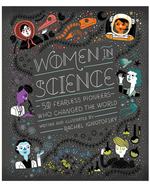
Women in Science: 50 Fearless Pioneers Who Changed the World
by Rachel Ignotofsky
Ages: 10+ years
Fifty women. Fifty fields. One book that belongs on every family's shelf. This illustrated reference profiles scientists, mathematicians, physicists, astronomers, and biologists from the ancient world to the present, including well-known figures like primatologist Jane Goodall alongside lesser-known pioneers like Katherine Johnson, the mathematician who calculated the trajectory of the 1969 Apollo 11 mission. Beyond the biographical portraits, the book includes infographics on lab equipment and women's representation in STEM fields, and an illustrated scientific glossary that invites a curious reader to linger rather than just flip through.
Why we like it: Most STEM resources teach children to do science. This one teaches them to see themselves in it. By grounding real scientific methods and discoveries in the stories of the people who made them, it builds the habit of asking who did this work, how they thought, and what they were up against. That question is a STEM skill too.
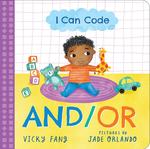
I Can Code: And/Or
by Vicky Fang
Ages: 3-6 years
Most coding books for young children stay decorative — friendly robots, colorful keyboards, the word "code" in the title. This one actually teaches something. And/Or introduces logical operators — the and/or, true/false distinctions that let you combine or qualify conditions — through a story about sharing. The lift-the-flap format asks children to reason through each outcome before revealing it, which mirrors how logical statements actually evaluate. The author is a former product designer who worked at Google and Intel Labs, and the instructional design reflects that: the concept is never explained, it's enacted. A natural companion to If/Then, the first book in this series.
Why we like it: Boolean logic is how computers make decisions. Introducing that structure through a story — before a child has ever seen a line of code — is exactly the kind of early conceptual scaffolding that sticks.
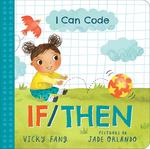
I Can Code: If/Then
by Vicky Fang
Ages: 3-6 years
Most coding books for young children stay decorative — friendly robots, colorful keyboards, the word "code" in the title. This one actually teaches something. If/Then introduces conditional logic through a story about a child and her dad at the park, where every cause-and-effect moment maps to a real programming concept: if this happens, then that follows. The lift-the-flap mechanic earns its keep here — your child acts out the logic before seeing the result, which is exactly how conditional thinking works. The author is a former product designer who worked at Google and Intel Labs, and that background shows in how cleanly the concept is embedded. Pairs well with And/Or, the companion book in this series.
Why we like it: The flaps aren't a gimmick — they make conditional reasoning something a child does, not just reads about. That physical decision point is a genuine introduction to how code thinks.
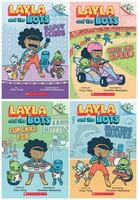
Layla and the Bots (Happy Paws, Built for Speed, Cupcake Fix, Making Waves)
by Vicky Fang
Ages: 5-7 years
Each book in this four-book series follows Layla and her robot friends as they identify a real-world problem and engineer a solution. The series was written by a former Google product designer, and that background shows: the full design process is here, from researching the problem and generating ideas to building a prototype, collecting feedback, and iterating until it works. That sequence is baked into the story, not explained in a sidebar. Each book also includes a companion hands-on project at the back, and free printable activity sheets are available on the author's website.
Why we like it: Most early chapter books feature inventors as characters but skip the actual thinking. This series shows your child what iteration looks like in practice: a plan that doesn't work, a revision, a result. That habit of returning to a problem after initial failure is one of the harder STEM skills to model at home, and this series does it quietly, inside a story kids actually want to read.
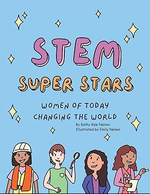
STEM Super Stars: Women of Today Changing the World
by Kathy Kale Nelson
Ages: 6-12 years
Most coloring books with a STEM theme pull from the same roster of historical names. This one doesn't. It features 25 women currently working across STEM fields -- bat biologist, crash-test engineer, astrophysicist, wind engineer, and more -- drawn from the author's own professional network built through years of hosting conversations with women in STEM. Each figure gets a coloring page with a brief blurb, plus real photos and substantive bios in the back, designed to be read together with a parent. The author is a career electrical engineer, and that background shows in how the women and fields were selected.
Why we like it: It works on two levels: the coloring pages give younger children a low-pressure entry point, while the back-section bios give older children and parents something to actually talk about. That structure is what makes this useful for building career identity -- the habit of connecting what your child is curious about to what real people actually do in STEM.
Amazing Inventions That Changed The World: The True Stories About The Revolutionary And Accidental Inventions That Changed Our World
by Bill O'Neill
Ages: 6-12 years
Ten inventions. Ten stories about what humans do when they run into a problem they can't ignore. This book walks through the history of paper, the compass, the printing press, the steam engine, electricity, vaccines, refrigeration, the airplane, penicillin, and the computer — not as a parade of eureka moments, but as a record of iteration, accident, and persistence. Each chapter traces what came before, what changed, and why it mattered. The writing is accessible, with sidebar facts that reward curious readers who want to go deeper.
Why we like it: The book frames invention as a process rooted in need and failure — not in genius alone. That's a useful frame for children learning to stick with a problem, and for parents looking for concrete examples of engineering thinking and scientific reasoning in action.
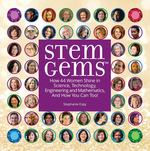
STEM Gems: How 44 Women Shine in Science, Technology, Engineering and Mathematics, and How You Can Too!
by Stephanie Espy
Ages: 13+ years
A collection of profiles of 44 women working across science, technology, engineering, and mathematics, this book makes the breadth of STEM careers visible in a way most kids never encounter. Each woman's story covers her path, the obstacles she navigated, and what her day-to-day work actually looks like. The career range is wide: chemical engineering, data science, aerospace, biomedical research, and more. It's written for girls and young women, but parents find it genuinely useful too, as a conversation starter and a reference for what's possible beyond the handful of STEM careers that tend to get all the attention.
Why we like it: It builds career imagination, the habit of picturing yourself doing something before you've been formally invited to try. That's a skill, and it's one of the quieter things STEM readiness depends on.
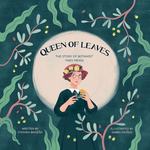
Queen of Leaves: The Story of Botanist Ynes Mexia
by Stephen Briseño
Ages: 6-8 years
A picture book biography of a plant scientist who refused to let convention stop her. Ynes Mexia came to botany later in life, at a time when women were rarely welcomed in field science. She went on to lead expeditions across Mexico, Central America, and South America, ultimately collecting nearly 150,000 specimens, discovering more than 500 new species, and naming a new genus entirely her own. The book uses the wax palm as a parallel narrator, threading Mexia's story through the biology of a plant that also survived against the odds.
Awards: NSTA Outstanding Science Trade Book, 2024
Why we like it: The parallel structure asks children to hold two ideas at once: a scientist's life and a plant's survival strategy. That kind of comparative thinking, weighing two systems side by side to find what they share, is a genuine scientific habit of mind. The scale of Mexia's real work also gives kids something concrete to sit with: 150,000 specimens is a number worth thinking about.
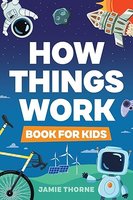
How Things Work: The Human Body, Plants, Animals, Seasons, Electricity, Computers, Smartphones, Flight, Architecture, Recycling, and More!
by Jamie Thorne
Ages: 8-12 years
If your kid has ever asked how a phone actually works, or why planes stay up, or what electricity really is, this is the book to hand them. How Things Work is a 148-page nonfiction paperback that moves through an unusually broad range of topics: human biology, electricity, computers, smartphones, flight, architecture, and recycling. It never feels scattered. Each subject is explained as a system, not a set of facts, which means kids are quietly practicing cause-and-effect reasoning that shows up across all of STEM. The writing is accessible without being dumbed down, and the format makes it easy to read in chunks.
Why we like it: Most kids' science books pick a lane. This one doesn't, and that turns out to be its strength. A page on electricity becomes a conversation about engineering; a section on smartphones connects to computers and communication. That cross-disciplinary thinking, seeing how fields overlap and build on each other, is exactly the habit worth building early.
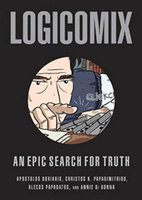
Logicomix: An Epic Search for Truth
by Apostolos Doxiadis & Christos Papadimitriou
Ages: 13+ years
Logicomix is a graphic novel that follows philosopher and mathematician Bertrand Russell through his decades-long obsession: finding an unshakable logical foundation for mathematics itself. Along the way he tangles with Frege, Hilbert, Gödel, and a young Wittgenstein, watches some of the greatest minds of the century unravel under the weight of paradox, and nearly loses himself in the process. The art is gorgeous, the ideas are real, and the central questions (what is truth, what can we actually prove, how do we know what we know) are exactly the ones that shape mathematical and scientific thinking.
Why we like it: It treats logic, proof, and abstract reasoning as a human drama, not a textbook exercise. For a curious reader who likes hard ideas and great storytelling, this is a rare gateway into the philosophy of math, and a reminder that the smartest people in the room often spend their lives stuck on the same question.