STEM at home
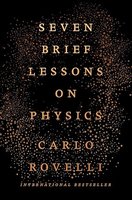
Seven Brief Lessons on Physics
by Carlo Rovelli
Ages: 13+ years
Fewer than a hundred pages. Seven short lessons. Together they cover the most consequential ideas in modern physics — Einstein's general relativity, quantum mechanics, the architecture of the cosmos, elementary particles, the strange granular nature of space and time, the thermodynamics of black holes, and the place of human beings inside all of it. Rovelli is a working theoretical physicist, but he writes like a poet, and he assumes nothing about what the reader already knows. The result is a book that genuinely makes general relativity and quantum theory feel reachable — not simplified, just clearly explained. A short, often startling introduction to how physicists actually think about the universe.
Why we like it: This is the rare physics book that a curious teen and a curious parent can read side by side and both come away changed. Rovelli treats the reader as capable, names the hard ideas plainly, and shows that wonder and rigor belong to the same impulse — exactly the mindset that keeps a kid in STEM for the long haul.
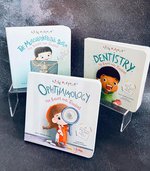
Little Doctors Children's Books Set: Volume 2: Lift-the-Flap (Ophthalmology, Dentistry & The Musculoskeletal System)
by Dr Haitham Ahmed
Ages: 2-4 years
The second set from Dr. Haitham Ahmed takes the same rhyming, illustration-rich approach and adds lift-the-flap interactivity — which means small hands stay engaged while big ideas sink in. Each book walks through a check-up from the child's point of view: symptoms, examination, treatment. Eyes, teeth, bones, and muscles get demystified through diverse characters and genuine medical vocabulary. Kids learn what to expect at a doctor or dentist visit, and parents get a natural entry point for conversations about anatomy, health, and how the body actually works.
Why we like it: Hands-on interaction is one of the most reliable ways young children learn, and these books turn a simple read-aloud into something closer to exploration. They also gently prepare kids for medical visits — lowering anxiety while building vocabulary around health, anatomy, and the science of the human body.
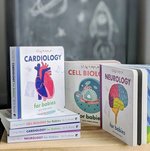
Little Doctors Children's Books Set – Volume 1 (Cardiology, Neurology & Cell Biology for Babies)
by Dr Haitham Ahmed
Ages: 2-4 years
Written by Dr. Haitham Ahmed, this board book set introduces the youngest readers to the heart, the brain, and the building blocks of life — with rhyming text, bright illustrations, and the kind of durability that holds up to real toddler handling. The vocabulary is unapologetically real: cardiologist, neuron, mitochondria. Kids won't understand every word on the first read, and that's the point. Repetition builds familiarity, familiarity builds curiosity, and curiosity is what eventually becomes real scientific interest. A quiet way to plant the seeds of biology and anatomy long before a child can spell either word.
Why we like it: Early exposure to real scientific language — not watered-down stand-ins — is one of the simplest ways to signal that science belongs in your child's world. These books do that without ever feeling like a lesson. They invite wonder about the body, which is exactly where a lifelong interest in biology, medicine, and how things work tends to begin.
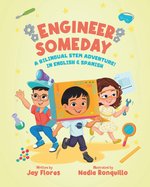
Engineer Someday: A Bilingual STEM Adventure in English and Spanish
by Jay Flores
Ages: 2-7 years
Engineer Someday is a picture book that turns the word "engineer" into something a young child can actually picture. Written by Jay Flores — who graduated as the only Latino in his mechanical engineering class — it walks through ten types of engineers, from aerospace and biomedical to software and civil, comparing each to something kids already love, like superheroes, chefs, and explorers. Kids tend to see the civil engineer page and reach for their blocks. The rhymes work in both languages, and the illustrations are bright and deliberately diverse. The goal: help your child see themselves in roles most won't hear about until much later.
Why we like it: Most kids don't know what an engineer actually does until high school — or later. This book closes that gap early, in a way that feels like play. The bilingual format is a gift for families raising curious kids in two languages, and the representation makes it easy for every child to picture themselves building or inventing.
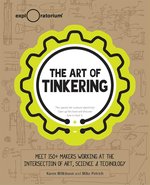
The Art of Tinkering: Meet 150+ Makers Working at the Intersection of Art, Science & Technology
by Karen Wilkinson and Mike Petrich
Ages: 8+ years
Some books tell your child what to do. This one shows them what's possible. Brought to life by the team behind the Exploratorium's Tinkering Studio, it profiles 150+ artists, engineers, and inventors working at the intersection of art, science, and technology. Toothpicks become cities. Masking tape becomes architecture. A 9-volt battery and some conductive ink turn the cover itself into a circuit.
Parents don't need a science background to use it. Flip through together, let your child pick a maker who sparks something, then grab whatever's in the junk drawer and follow their lead. Expect engineering, circuitry, mechanical design, soft electronics, and a lot of joyful problem-solving.
Why we like it: This book captures something we believe deeply — that the strongest STEM foundation is built through play, exploration, and the freedom to try, fail, and try again. It doesn't tell your child what to make. It shows them how makers think, then hands them the tools to find their own way in.
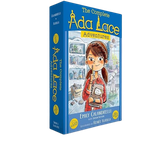
The Complete Ada Lace Adventures (Boxed Set)
by Emily Calandrelli
Ages: 6-8 years
Ada Lace is a third-grade inventor with a notebook full of observations, pet turtles named Hydrogen and Oxygen, and a knack for solving neighborhood mysteries the way a scientist would — asking questions, gathering evidence, building something if nothing off the shelf will do. Written by Emily Calandrelli, the MIT-trained engineer behind Netflix's Emily's Wonder Lab, this six-book series follows Ada as she investigates a missing dog, cracks an extraterrestrial code, builds a robot for best friend Nina, and more. Your child sees the scientific method applied to everyday problems — field journaling, hypothesis testing, engineering design — without it feeling like a lesson.
Awards: NSTA Best STEM Book; selected for NASA's Story Time from Space
Why we like it: Ada actually does science — methodically, curiously, without apology for being different. The friendship at the heart of the series reflects what we believe: creativity and scientific thinking strengthen each other.
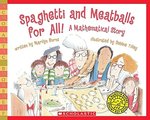
Spaghetti and Meatballs for All!
by Marilyn Burns
Ages: 4-8 years
Spaghetti and Meatballs for All!
Mrs. Comfort has it all figured out — eight tables, four chairs each, room for every one of the thirty-two relatives coming to the family reunion. Then the guests start arriving, and everyone has an opinion about how the tables should be arranged. Marilyn Burns turns a chaotic dinner party into a clear lesson in area and perimeter, showing how the same tables can hold wildly different numbers of people depending on how you push them together. The note at the back offers simple ways to keep the conversation going after the last page.
Why we like it: It does what the best math stories do — hides the math inside something a child already cares about. Area and perimeter are notoriously slippery on a worksheet. Here, they land, because your child can feel why Mrs. Comfort was right all along. A quiet case study in how spatial reasoning shows up at the dinner table, not just in a textbook.
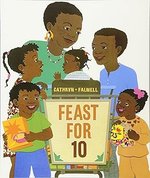
Feast for 10
by Cathryn Falwell
Ages: 4-7 years
Feast for 10 is a counting board book that turns a family grocery run and dinner prep into early math practice. The rhythmic text walks through counting forward and backward, number recognition, and the beginnings of addition and subtraction — all wrapped inside a warm story about a Black family shopping, cooking, and sharing a meal. The math is everywhere once you start looking: comparing quantities, noticing what changes when something is added or taken away, connecting numbers to real moments like setting the table. To bring it further to life, try counting with real or pretend food, acting out scenes, and asking questions like "How many now?" or "What if we add one more?"
Why we like it: Early math sticks when it's tied to something real, and Feast for 10 does exactly that — turning counting into a story your child will ask for again and again.
The Doorbell Rang
by Pat Hutchins
Ages: 2-8 years
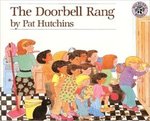
Pat Hutchins' The Doorbell Rang turns a plate of cookies into a quiet lesson in division — without ever calling it that. Ma bakes a dozen cookies for her two children to share. Then the doorbell rings. And rings. And rings. Each new arrival means the cookies have to be split again, and the math gets more interesting every time. Kids start predicting, counting, and comparing on their own — working out equal groups and bumping up against early ideas of remainders. It rewards real objects on the table: crackers, grapes, pretend cookies, anything countable. Ask how many now? and what if one more friend came?
Awards: Notable Book for Children, American Library Association
Why we like it: A lovely reminder that math lives inside everyday moments — sharing a snack, setting the table, welcoming guests — which is exactly the kind of foundation STEM is built on.
STEM SMART Parenting: A Practical Guide for Nurturing Innovative Thinkers
by Allan Zollman, Lisa Hoffman and Emily K. Suh
Ages: Adult
Three educators — and parents — did the research so you don't have to. STEM SMART Parenting unpacks what the science actually says about how kids develop the skills that matter most: critical thinking, productive struggle, creative problem-solving, and the willingness to take intellectual risks. It moves past the marketing noise of the toy aisle and gives parents a practical, research-backed framework for evaluating what's worth your child's time — and what isn't. Each chapter builds on the last with real examples and no-cost ideas families can use anywhere.
Why we like it: Most parenting books tell you STEM is important. This one shows you how to build the foundation — the curiosity, the resilience, the risk-taking mindset — that makes all the programs and toys actually work. It also gives you a smart, honest way to evaluate the products that promise the world. That's rare, and genuinely useful.