STEM at home

MEL Science
Ages: 8+ years
MEL Science delivers monthly chemistry and physics kits that go well beyond craft-kit territory. The chemistry track ships certified reagents, Pyrex glassware, and real reactions: tin dendrites grown with electricity, hydrogen combustion, pH color changes. The physics track builds working models of everyday devices and explores electromagnetism and polarized light. Both tracks pair each experiment with a VR/AR app that lets kids visualize molecular structure or physical principles right after the lab. This is a co-pilot subscription: an adult works alongside the child, and that shared time is part of the design.
Gotham STEM recommends the Chemistry and Physics tracks only. The other available tracks operate at a different level of rigor.
Why we like it: After each experiment, the VR/AR layer asks kids to explain what happened at the molecular level, not just observe that it did. That shift from procedure to causal reasoning is where real scientific thinking takes hold.
Picasso Tiles Building Blcoks with Car and Carry Bag
Ages: 3+ years
Translucent geometric pieces that connect along their edges and give a child complete freedom over what comes next. No instructions, no set outcome. Kids build towers, ramps, and enclosures; knock them down; rebuild with more ambition. Screenless, tactile, replayable.
Weighing these against Magna-Tiles: formats are compatible and the experience is similar. The main difference is price. These run about three times more tiles per dollar, which matters when building a large set. Build quality is slightly lower (glue bonding rather than riveted, marginally weaker magnets), but parents report years of use without issue.
No curriculum or challenge cards. Value comes entirely from the child's own building, not an instructional layer.
Why we like it: Free building with magnetic tiles builds spatial reasoning and geometry intuition through cause and effect. When a structure collapses, a child gets direct feedback on load, balance, and polarity. That feedback loop is the lesson.

Mark Rober YouTube Channel
Ages: 8+ years
Mark Rober spent nearly a decade as a NASA engineer on projects including the Mars Curiosity rover, and his videos are built the way engineering actually works: identify a problem, try something, watch it fail, figure out why, and go again. Physics, mechanical engineering, biology, and applied mathematics all show up here, tied to a real experiment. Kids who have never warmed to science often connect with this channel because the problems are specific and Rober is clearly invested in solving them.
One thing to know: your child will be watching, not doing. And several videos weave in promotion for a paid subscription kit line in ways that are not always easy for kids to distinguish from the content itself.
Why we like it: Rober models engineering persistence without ever naming it. Kids see someone genuinely stuck, genuinely working through it, and genuinely pleased when something finally works. That picture of how problem-solving actually feels is harder to find than it should be.
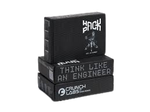
Crunch Labs Hack Pack Subscription
Ages: 14+ years
The Hack Pack is a bi-monthly subscription for teens and adults that goes beyond building into engineering iteration. Each box includes everything needed to construct a working robot-scale mechanism, such as a motion-sensing IR turret, a sand garden, or a password-protected candy vault, along with an Arduino microcontroller, power bank, and a browser-based coding console. The build comes first. Then comes the hacking: modifying the machine's behavior through code, working with servo motors, IR sensors, and embedded programming. Projects are designed to be extended and personalized, not just completed.
Awards: Good Housekeeping 2025 Toy Award.
Why we like it: Most STEM kits stop at assembly. Hack Pack starts there. When a teenager rewrites how a machine behaves after building it, they are practicing the iterative design loop that real engineers use: build, test, change, test again. That is a different cognitive skill than following instructions, and genuinely harder to find at home.
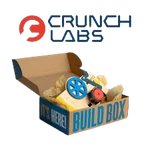
Crunch Labs Build Box Subscription
Ages: 8-12 years
The Build Box is a monthly subscription that delivers a working mechanism each month: a disc launcher, a drawing bot, a chain reaction machine. All parts, illustrated instructions, and a companion video from Mark Rober, a former NASA engineer, explaining the physics behind the build are included. Each project is anchored to a specific concept: momentum transfer, light refraction, mechanical advantage. Kids work through the build independently, and the video walks through both the how and the why. No extra materials needed.
Awards: Good Housekeeping 2025 Toy Award.
Why we like it: Each build connects a physical cause to an observable effect. A child who constructs a disc launcher and then watches Rober explain why angular momentum keeps it stable is doing more than following instructions. That cause-and-effect reasoning is the foundation of scientific thinking.
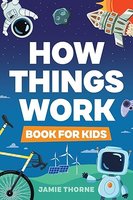
How Things Work: The Human Body, Plants, Animals, Seasons, Electricity, Computers, Smartphones, Flight, Architecture, Recycling, and More!
by Jamie Thorne
Ages: 8-12 years
If your kid has ever asked how a phone actually works, or why planes stay up, or what electricity really is, this is the book to hand them. How Things Work is a 148-page nonfiction paperback that moves through an unusually broad range of topics: human biology, electricity, computers, smartphones, flight, architecture, and recycling. It never feels scattered. Each subject is explained as a system, not a set of facts, which means kids are quietly practicing cause-and-effect reasoning that shows up across all of STEM. The writing is accessible without being dumbed down, and the format makes it easy to read in chunks.
Why we like it: Most kids' science books pick a lane. This one doesn't, and that turns out to be its strength. A page on electricity becomes a conversation about engineering; a section on smartphones connects to computers and communication. That cross-disciplinary thinking, seeing how fields overlap and build on each other, is exactly the habit worth building early.

3M Young Scientist Lab: Science at Home
Ages: 8-14 years
Science at Home is a free video series produced by 3M scientists and special guests, built around a straightforward premise: real science happens with whatever is in front of you. Each short experiment uses common household materials, from spaghetti and marshmallows, milk and dish soap, baking soda and vinegar, to explore concepts like structural engineering, chemical reactions, surface tension, the Bernoulli principle, and kinetic energy. The experiments are taught on camera by working scientists, which means kids aren't just watching a trick. They're watching someone who actually does this work explain why it happens.
Why we like it: Each experiment is anchored to a specific scientific concept, and the scientists explain the underlying reasoning, not just the steps. That's the difference between a demo and a learning moment. Kids build real scientific vocabulary while testing cause and effect with materials already in your kitchen.

Green Kid Crafts
Ages: 3-10 years
Each month, a Green Kid Crafts box arrives with 4 to 6 hands-on STEAM projects built around a single theme: Backyard Science, Green Energy, Outer Space, and more. Founded by environmental scientist Penny Bauder, the subscription is designed around nature-based inquiry, using eco-friendly materials to draw connections between scientific thinking and environmental responsibility. Projects span science, engineering, art, and math, and every box includes a 12-page activity magazine with guided prompts that develop observation, hypothesis-testing, and creative problem-solving skills.
Awards: Parents' Choice Award; Academics' Choice Brain Toy Award; NCW Eco-Excellence Award; Red Tricycle Most Awesome Subscription Service Award.
Why we like it: Every theme is a framework for systems thinking. Kids aren't just making things, they're asking why materials behave the way they do and what that means for the world around them. The environmental lens makes the science feel real.

Logicomix: An Epic Search for Truth
by Apostolos Doxiadis & Christos Papadimitriou
Ages: 13+ years
Logicomix is a graphic novel that follows philosopher and mathematician Bertrand Russell through his decades-long obsession: finding an unshakable logical foundation for mathematics itself. Along the way he tangles with Frege, Hilbert, Gödel, and a young Wittgenstein, watches some of the greatest minds of the century unravel under the weight of paradox, and nearly loses himself in the process. The art is gorgeous, the ideas are real, and the central questions (what is truth, what can we actually prove, how do we know what we know) are exactly the ones that shape mathematical and scientific thinking.
Why we like it: It treats logic, proof, and abstract reasoning as a human drama, not a textbook exercise. For a curious reader who likes hard ideas and great storytelling, this is a rare gateway into the philosophy of math, and a reminder that the smartest people in the room often spend their lives stuck on the same question.
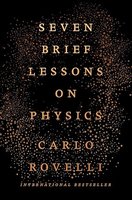
Seven Brief Lessons on Physics
by Carlo Rovelli
Ages: 13+ years
Fewer than a hundred pages. Seven short lessons. Together they cover the most consequential ideas in modern physics — Einstein's general relativity, quantum mechanics, the architecture of the cosmos, elementary particles, the strange granular nature of space and time, the thermodynamics of black holes, and the place of human beings inside all of it. Rovelli is a working theoretical physicist, but he writes like a poet, and he assumes nothing about what the reader already knows. The result is a book that genuinely makes general relativity and quantum theory feel reachable — not simplified, just clearly explained. A short, often startling introduction to how physicists actually think about the universe.
Why we like it: This is the rare physics book that a curious teen and a curious parent can read side by side and both come away changed. Rovelli treats the reader as capable, names the hard ideas plainly, and shows that wonder and rigor belong to the same impulse — exactly the mindset that keeps a kid in STEM for the long haul.