STEM at home
KEVA Planks
Ages: 5+ years
Every plank is the same size. No connectors, no sorting, no instructions. Just wooden blocks and whatever your child decides to build. When a tower falls, gravity delivered the feedback, not a parent. The child adjusts, rebuilds, tries again. Used in science museums and classrooms worldwide since 1992. The base sets are open-ended; the Contraptions line adds ball runs for guided builds, and Brain Builders introduces puzzle cards with specific 3D targets. The flagship sets are milled from American maple. KEVA Structures offers the same core experience in pine at a lower price point.
Awards: Oppenheim Toy Portfolio Platinum Seal 2025; NAPPA National Parenting Product Award 2025; Family Choice Award 2025
Why we like it: The single-shape, no-connector design forces spatial reasoning at its most honest. Balance, proportion, and structural load are all tested by actual gravity on every attempt. There is no forgiving snap to hold a bad build together.
Rainbow Fraction Tower® Cubes
by hand2mind
Ages: 8-12 years
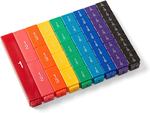
Fractions stay abstract for a long time. These interlocking cubes make them physical: because each cube is proportionally sized to its fraction value, snapping four one-quarter pieces together produces a tower exactly as tall as the whole. Equivalency stops being something to memorize and becomes something a child can see and test. The set covers nine fraction values, from whole to twelfths, and extends into operations including addition and subtraction with unlike denominators. No activity guide is included. This works best when an adult comes prepared with questions. Hand2mind offers free facilitation resources on its site. Worth noting: the Fraction Tower Equivalency Cubes, which add decimal and percent labeling, are sold at the same price and may be the better buy.
Why we like it: The 3D format does something flat tiles cannot: it makes equivalency physically testable. A child building and comparing towers is developing proportional reasoning, not just pattern recognition.
Rainbow Fraction Tiles with Tray
by Learning Resources
Ages: 6+ years
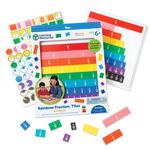
Fractions trip up a lot of kids because the math is invisible. You can tell a child that two-fourths equals one-half, but until they hold the pieces side by side and see it, the idea stays abstract. That is where this set earns its place. The 51 color-coded, proportional plastic tiles cover the standard fraction curriculum from halves through twelfths. The proportional sizing is the key feature: pieces physically match their values, so a child can line up three 1/3 tiles against the whole and watch the relationship become concrete. A plastic tray keeps everything organized, and a teaching guide is included. This is a classroom staple that works equally well at the kitchen table, especially when a parent is on hand to pose follow-up questions.
Why we like it: The proportional design pushes a child to reason about equivalency rather than memorize it. When they ask why two different tile combinations fill the same space, that is genuine mathematical thinking happening.
Shut the Box
Ages: 5+ years
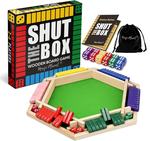
Shut the Box started as a pub game, likely in 18th-century Normandy, and it has outlasted most things invented for entertainment since. Two dice, nine numbered tiles, and the goal of closing every tile before your luck runs out. The math is real: each roll requires figuring out which combination of open tiles adds up to your total. A roll of eight might close tiles 3 and 5, or 1 and 7, or just the 8 alone. That choice is the whole game. Number decomposition and mental addition happen on every turn, and the probability of pulling off a clean sweep is genuinely hard to calculate, which keeps it interesting well past the basics. The game works solo or with up to four players and packs flat for travel.
Why we like it: The real learning is in recognizing that most rolls have several valid solutions. Asking your child why they chose one tile combination over another turns a dice game into a genuine number reasoning conversation, which is harder to engineer than it sounds.
Infento Kits (Adventure / Innovator / Volt / Ultimate)
Ages: 4+ years
Infento kits let families build life-size, rideable vehicles from aluminum profiles, connectors, and fasteners, assembled with a hex key. Four tiers (Adventure, Innovator, Volt, and Ultimate) range from walkers and balance bikes to go-karts and electric quads, sharing one parts library so builds scale over years. Each kit includes manuals; the system supports open-ended design when your child is ready. First builds take real adult time and the assembly is genuinely complex. Families who embrace that consistently describe it as a multi-year project.
Awards: Red Dot Design Award (2018); German Design Award; Parents' Choice Gold Award
Why we like it: A vehicle assembled incorrectly won't roll right. That mechanical feedback builds structural reasoning and iterative troubleshooting in a way no worksheet can. Children learn to read technical diagrams, sequence steps, and stay with a problem through the hard middle. Those habits translate directly to engineering and physics thinking.

Numberblocks
Ages: 3-6 years
It is a story of friends who can always count on each other, and also a sequenced math curriculum. Numberblocks is an animated series where stacked-block characters join, split, and rearrange to show how numbers work, covering number recognition, counting, addition, subtraction, multiplication, and division across 90 episodes in five levels. Developed with the UK National Centre for Excellence in the Teaching of Mathematics, the progression is real. The companion website organizes episodes by level and adds printable activities. US families can watch on YouTube or Netflix. A paid app adds offline access and quizzes.
Awards: BAFTA, Children's Preschool Animation (2019); DfE recommended for home learning.
Why we like it: Most early math content teaches children to count. This one teaches them to see how numbers are built. A parent in the room asking questions is the difference between a good show and a real math lesson.
OLogy
by American Museum of Natural History
Ages: 8+ years
OLogy is a free science site built by the American Museum of Natural History, covering 14 disciplines including paleontology, genetics, marine biology, astronomy, and climate change. Content is organized by topic and activity type, spanning reading, games, hands-on offline projects, and short videos. A companion iPad app offers a curated selection of the same activities offline, with no ads. The website has been a classroom and home resource for over two decades, developed alongside working scientists. New material is added infrequently, but the existing library is deep enough that most curious kids won't exhaust it quickly.
Why we like it: OLogy works well as a follow-up to something your child already encountered, a dinosaur exhibit, a nature documentary, a question that came up at dinner. It builds the habit of going deeper: reading past the headline, meeting the scientists behind the work, and connecting a topic like genetics or archaeology to the real researchers who study it.
PhET Interactive Simulations
by University of Colorado Boulder
Ages: 6+years
The Physics Education Technology Project (PhET) is a free library of more than 150 research-based simulations covering physics, chemistry, biology, earth science, and mathematics, built by University of Colorado scientists and available on any browser or as a low-cost app. Each simulation puts your child in control of something normally invisible: molecular motion, electrical circuits, wave behavior, probability. Change a variable and watch the system respond, instantly.
Awards: WISE Award, World Innovation Summit for Education; APS Excellence in Physics Education Award; NSF & Science Magazine Visual Challenge in Science & Engineering
Why we like it: Every sim is built around cause-and-effect reasoning: predict, adjust, observe. That is how scientific thinking develops. These sims reward a parent who asks what happens if we change this and stays for 20 minutes. Left to click alone, kids drift. Co-explore and something genuinely interesting happens.

Earth Odyssey with Dylan Dreyer
by NBC
Ages: 7+ years
Each episode of Earth Odyssey takes your family to a different corner of the planet: African savannas, Indonesian islands, the rivers of France, spending a half hour with the wildlife, ecosystems, and conservation of that place. The host is Dylan Dreyer, a TODAY Show meteorologist, which means the science is handled by someone who thinks about natural systems for a living. Content covers animal adaptation, food chains, symbiosis, biodiversity, and habitat across eight seasons of original episodes. It airs Saturday mornings on NBC at no cost and streams on Peacock and Prime Video.
Awards: Five national Telly Awards
Why we like it: This is a reliable way to build ecological literacy, the specific vocabulary of how living systems depend on each other. Kids who watch with a curious question in mind (why do animals in cold climates look the way they do?) come away with real content to work with, not just entertainment. Best used as a conversation starter, not a destination.
Superhuman Body: World of Medical Marvels
Ages: 5+ years
This 40-minute giant-screen documentary takes you inside the human body and the labs of scientists working to repair it. Narrated by Academy Award winner Matthew McConaughey, it follows real people transformed by bioengineering: a teenager whose leukemia was eliminated through CAR T-cell therapy, an engineer who lost both legs and now designs bionic limbs, a roboticist whose machines help children with disabilities. The filmmaking makes the science visceral. It plays at the New York Hall of Science in Queens; schools can arrange a field trip to NYSCI or request a streaming link.
Awards: Giant Screen Cinema Association Best Film for Lifelong Learning, 2025
Why we like it: The film treats science as a human process driven by curiosity, setbacks, and persistence. Watching researchers explain their thinking builds the model-making habit we want kids to carry into any STEM context. Activity guides on osmosis, cellular respiration, and cardiac modeling are free on the film's site.