Ask most parents what they want from a STEM education, and you’ll hear some version of the same answer. They want their child to be prepared. To have options. To be ready for whatever comes next.
That’s completely fair. But here’s what gets lost in that conversation: the skills that actually drive success in STEM aren’t the technical ones. They’re what happens when children learn how to think — not just what to think.
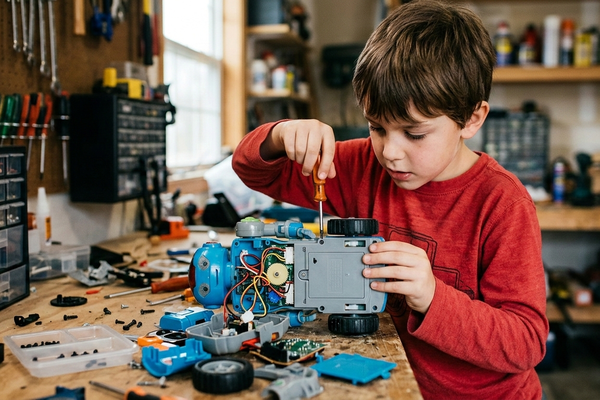
Think about the kid who takes apart a broken toy just to see how it works. The one who builds something, watches it fall apart, and immediately starts figuring out why. The one who can’t stop asking questions — even inconvenient ones, even ones nobody has the answer to yet.
That child already has the foundation. Everything else can be taught.
Curiosity isn’t a nice-to-have. It’s what makes everything else possible. And here’s something I wish more parents heard: the vast majority of children start out with curiosity in abundance. The question isn’t how to give it to them — it’s how to make sure it doesn’t get squeezed out along the way.
Coding languages change. Curricula evolve. But the ability to think critically, to collaborate, to sit with a hard problem and not give up — that’s what endures. That’s what we’re actually trying to build.
The drive to figure things out isn’t something you can find in a curriculum guide. It grows through play, through exploration, through the freedom to experiment and fail and try again. It thrives when kids feel safe enough to be wrong and supported enough to keep going.
This is why environment matters so much — and why I’ve always paid close attention to it when evaluating programs. Not just what’s listed on the website, but the feel of the room. The pace. The way an instructor responds when a child gets something wrong. A classroom that rewards the right answer is a very different place from one that rewards the right question. Both exist. They don’t produce the same child.
When parents evaluate STEM programs, the instinct is often to focus on outcomes: What skills will my child learn? What will they be able to do? Those aren’t bad questions — but they’re not the most revealing ones. The more important questions are about process.
- Does the program give kids room to struggle productively? A child who is always given the answer never learns to find it themselves. Look for programs where confusion is treated as a starting point, not a problem to be solved by the instructor.
- Are mistakes treated as data, or as failure? This one tells you almost everything. An instructor who responds to a wrong answer with curiosity — “Interesting, why do you think that happened?” — is building something very different from one who simply corrects and moves on.
- Is your child an active participant, or a passive one? Watch for how much time kids spend doing versus watching. Real STEM learning is hands-on from the start — not a demonstration followed by a worksheet.
- Does it teach children what to think, or how to think? A program that checks every box on paper but runs on rote instruction isn’t building a STEM mind. A scrappy afterschool club where kids argue over solutions, fail repeatedly, and figure it out together might be doing something far more valuable.

STEM education doesn’t begin and end with enrollment. Some of the most powerful learning I’ve seen happens in the in-between moments — a long car ride, a rainy afternoon, a question that comes out of nowhere at dinner.
A podcast that sparks a conversation. A book that a child carries around for weeks. A building kit that turns into a three-hour obsession. These aren’t supplements to real learning. For many children, they are the real learning. What you keep at home, what you put on in the car, what you hand a child on a plane — it all adds up.
No single program, class, or experience is going to determine who your child becomes. But the environment you build around them — the questions you encourage, the programs you choose, the resources you reach for — shapes how they learn to think.
That’s a longer game than any single enrollment decision. It’s worth playing it intentionally.
Looking for NYC programs that prioritize how children think, not just what they learn? Every program in the Gotham STEM directory is evaluated for the environment it creates — not just the skills it teaches.