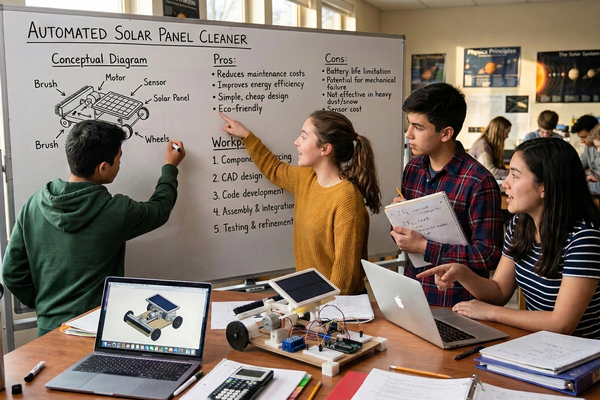
There’s a moment most parents recognize. Your child is working on something — a puzzle, a building project, a problem they invented themselves — and they hit a wall. Then, instead of walking away, they try something different. They adjust. They figure it out. That moment is worth paying attention to.
It’s not just persistence. It’s the beginning of a whole way of moving through the world. And it’s exactly what strong STEM experiences are designed to build.
Ask most parents what they want from a STEM program and you’ll hear something like: coding skills, math confidence, preparation for the future. All fair. But the most lasting thing STEM education builds isn’t a skill set — it’s a way of approaching the world.
This isn’t a new idea — it just keeps getting confirmed. Progressive educators in New York City were building schools around this principle over a hundred years ago. Caroline Pratt founded City and Country School in Greenwich Village in 1914 on the belief that children learn by doing. Elisabeth Irwin opened Little Red School House in 1921 with the same conviction. Bank Street College was founded that same year specifically to study how children actually learn — and Bank Street School for Children has been a working model of that research ever since.
Bank Street School for Children describes its classrooms plainly: “collaborative, lively, messy — a place where children’s innate curiosity is nurtured and guided by masterful educators who teach children how to think, not what to think.” That phrase is doing a lot of work. It’s the whole argument.
What all of these schools understood — and what researchers at Teachers College and elsewhere have continued to confirm — is that when children discover ideas through experience rather than instruction, the learning sticks in a way that listening and watching simply doesn’t replicate. STEM at its best is built entirely on this premise. Languages change. Curricula evolve. But the ability to reason through a hard problem, try again after a setback, and move through uncertainty with confidence? That’s the whole point.
Strong STEM experiences develop a cluster of abilities that research keeps returning to — not because they’re trendy, but because they’re the ones that actually determine how a child handles challenges, inside the classroom and out.
- Critical thinking and the ability to analyze. When children are given real problems to work through — not worksheets with predetermined answers, but actual open-ended challenges — they build the habit of examining a situation from multiple angles. That’s a skill that shows up in every hard thing they’ll ever face.
- Persistence through difficulty. STEM is iterative by nature. Something doesn’t work, you figure out why, you try again. Children who grow up practicing this learn, at a deep level, that struggle isn’t a reason to stop — it’s a sign they’re getting somewhere.
- Collaboration and communication. Real STEM work is almost never solo. Children working through shared challenges learn to articulate their thinking, listen to a different approach, and build on someone else’s idea. City and Country has been practicing this for over a century — their Jobs Program gives every grade a real responsibility that serves the whole school, from running the post office to managing the supply store. It’s collaboration in the most genuine sense.
- Confidence to try something new. A child who has been encouraged to experiment, who has seen that a wrong answer is just information, approaches unfamiliar situations differently. They raise their hand. They take the risk. They say “I don’t know yet — but I can figure it out.”
- Curiosity as a lasting habit. When a child’s natural instinct to wonder is met with encouragement rather than correction, it grows stronger over time. It becomes the lens through which they see the world — and that lens makes them a better learner in every subject, not just STEM.
Here’s the question worth asking about any program your child encounters: does it teach children what to think, or how to think?
A program that teaches what to think gives children answers and asks them to reproduce them. A program that teaches how to think gives children problems and trusts them to work through the uncertainty. The first builds compliance. The second builds thinkers.
The best STEM environments understand this distinction and design for it deliberately. You can feel it the moment you walk into the room — in how the instructor responds when something goes wrong, in whether kids are building something they designed or assembling a kit with a predetermined outcome, in whether the room feels alive with questions or quiet with instruction.

Parents often assume STEM becomes relevant somewhere around middle school. The research points somewhere else entirely. The habits of mind that STEM builds — curiosity, persistence, the willingness to try — are being shaped long before any formal program begins.
Bank Street has been documenting this since 1916, when Lucy Sprague Mitchell founded the institution specifically to study how children learn through observation, play, and hands-on exploration. What she found has been confirmed by every generation of researchers since.
The child stacking blocks and rebuilding after each collapse. The one mixing things at the kitchen table and asking what happens next. The one who can’t stop asking why. They’re already doing STEM. They just don’t know it yet.
Our job — as parents, as the adults in the room — is to protect that instinct and give it somewhere to go.
No single program will determine who your child becomes. But the environment you build around them — the questions you encourage, the spaces you find, the habits you model — shapes how they learn to think. That’s worth being intentional about.
At Gotham STEM, every program in our directory is evaluated not just for what it teaches, but for the kind of thinking it builds. Browse our curated collection to find the right fit for your child — wherever they are right now.